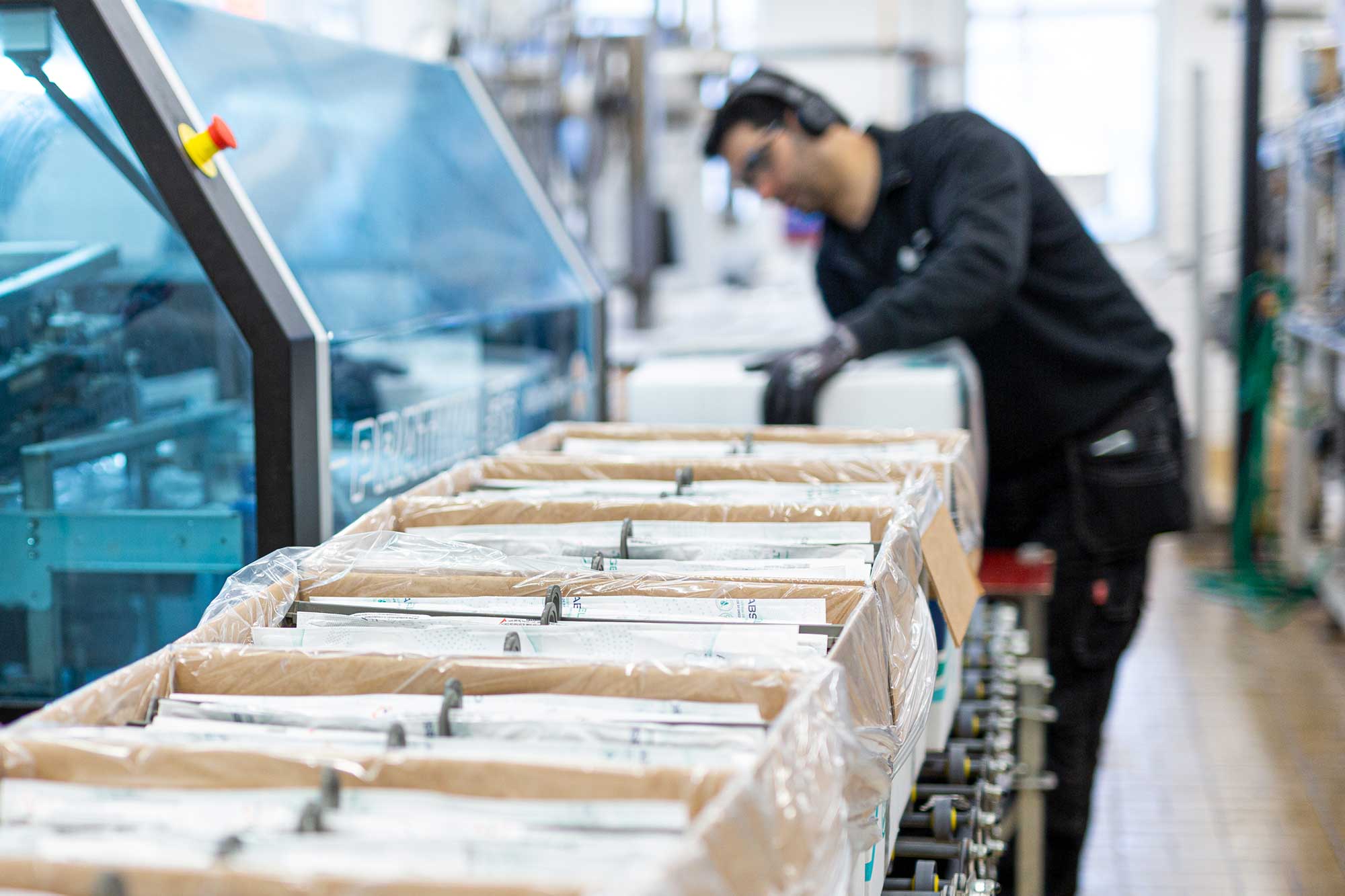
Thirty years ago, Absortech began with a deceptively simple question: why was moisture still compromising cargo within shipping containers? As the company marks its thirtieth anniversary, founder Thomas Johansson revisits the origins of its first solution and the problem that came to define its approach to moisture protection.

When Thomas Johansson first turned his attention to condensation within shipping containers, he presumed the problem had long since been resolved. Containers had underpinned global trade since the 1960s, yet moisture damage remained a persistent concern for enterprises transporting goods from Asia to Europe and the United States. Consignments continued to arrive compromised, as moisture gave rise to mould, corrosion and packaging failure in transit.
“If millions of containers are shipped every day and everyone encounters the same problem, surely someone must already have solved it,” Thomas recalls. “And yet no one had.”
Arriving at answers was far less straightforward then than it is today. This preceded the internet, and so Thomas acquired his understanding by consulting people throughout the industry, conferring with suppliers and methodically testing the possibilities. The materials then in common use afforded only limited protection.
“What existed at the time were large sacks of clay or silica gel, frequently suspended in the corners of the container,” he says. “They absorbed a degree of moisture, though far from efficiently, and they encroached upon space that belonged to the cargo.” A further limitation compounded the difficulty. Under fluctuating temperatures, absorbed moisture could be released once more. Across protracted sea voyages, this meant that protection could not be relied on precisely when it was most required.
Finding the right material
Thomas was familiar with calcium chloride from its use in road salt, and that familiarity directed him toward a solution. He approached a calcium chloride producer in Helsingborg, Sweden, who helped him comprehend the material and conduct the earliest trials.
The findings were unequivocal. Calcium chloride absorbed considerably more moisture than clay or silica gel and, decisively, it retained what it had absorbed. “Every gram of water it absorbs, it retains,” Thomas says. This became one of the founding principles of Absortech’s product development: a solution had to perform under authentic container conditions, and not merely in theory.
Hidden in the wall
The first product was a paper pole, approximately 1.2 metres in length, with calcium chloride housed in the upper section and a collector beneath. The intention was not merely to enhance absorption, but also to exploit the container itself more intelligently.
“There is a great deal of unused space within the container wall,” Thomas says. “Our principle was simple: make use of that space and take nothing from the cargo.” That reasoning gave rise to the Absorpole, a solution engineered to conform to the container wall profile, safeguarding the shipment without encroaching upon loading capacity.
For customers, this distinction was significant. Moisture protection had to be effective, yet it also had to be practical: it could not interfere with the way goods were packed, loaded or transported.
From first tests to first customers
Once the product had been refined, the subsequent challenge was to bring it to market. “Everyone to whom we presented it was enthusiastic,” Thomas says. “Yet we had no organisation whatsoever. Nothing at all.”
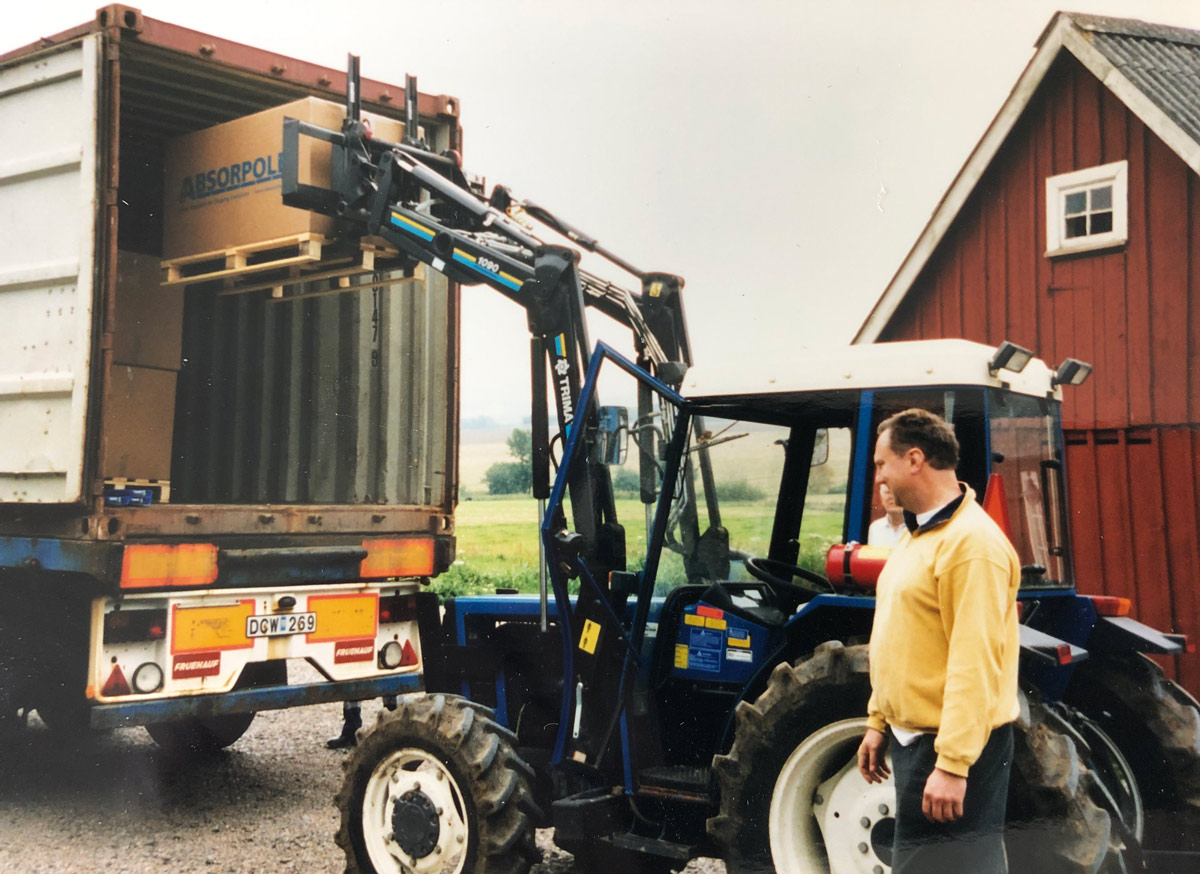
The earliest progress came through people and relationships. A partner furnished the initial financial backing and several valuable introductions. A Swedish contact in Singapore helped introduce the product to the shipping sector, while friends in Indonesia supported the first sales there. In Jacksonville, Florida, John Howe — a Swede already established in container-lashing equipment — swiftly recognised the product’s potential.
Early production was no less hands-on. Thomas constructed the machine lines himself and installed them with Samhall, the Swedish enterprise that provides employment for people with disabilities. It was a pragmatic beginning: to build, test, refine and sell; and to learn from each successive step.
The hallelujah moment in Porto
The product performed, but it proved too intricate to manufacture. Thomas, an automation engineer by training, reconceived the pole around a telescopic collector that served simultaneously as its own packaging. Nothing further needed to be shipped, and a greater number of poles could be accommodated within a single container en route to customers.
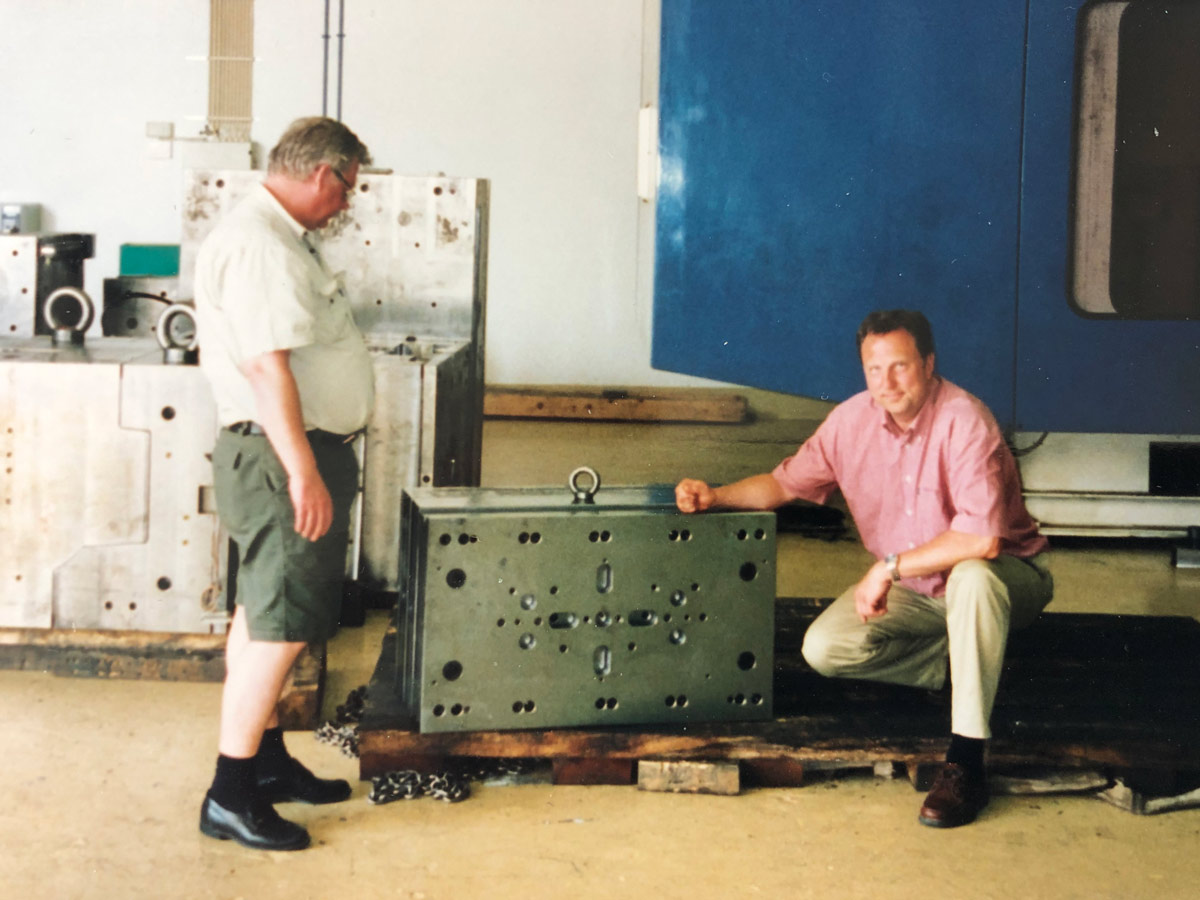
The new design required a plastic mould, and a mould must be correct from the outset. Thomas dispatched the drawings to a toolmaker in Porto and, six months later, travelled there with his wife, Christina, to witness the first test.
“When the mould opened and the first plastic pole emerged, I held it in my hand,” he says. “That was a hallelujah moment.” For Thomas, it was the moment at which months of drawings, testing and deliberation became something tangible.
Absortech: a name that says something
Absortech very nearly bore a different name. Thomas had initially settled upon a Latin word meaning “to dry out”. He remained fond of the idea, yet it did not translate well internationally.
“Thomas, you cannot call it that,” John Howe told him, the same associate who had recognised the product’s potential in Florida. With the guidance of consultants, the company settled upon Absortech, a name capable of uniting the wider product family, from Absorpole to Absorbag and the solutions that followed. “Some names convey nothing,” Thomas says. “This one declares that something absorbs something.”
Another defining occasion arose at a distributor conference in London in the early 2000s. Some twenty people travelled from countries including Ireland, the United States, India, Germany, Singapore and Indonesia — a number of whom Thomas was meeting for the first time. “They had travelled all that way to gather around a single table and see this plastic pole,” he says. “They believed in it. They placed their trust in me.”
Still solving the same problem
Thirty years on, what affords Thomas the greatest pride is not merely the first product or the early milestones, but what Absortech has become. “It is seeing the company as it is today,” he says.
“The team, the new generation, and the way the company has endured.”
A great deal has changed since the formative years. When Thomas began, selling frequently meant carrying the product beneath his arm and knocking on doors. Today, Absortech has teams across 8 countries and a global distribution network in more than 75 countries. The company supplies and collaborates with customers all over the world, supported by tools and technologies that did not exist when the company began.
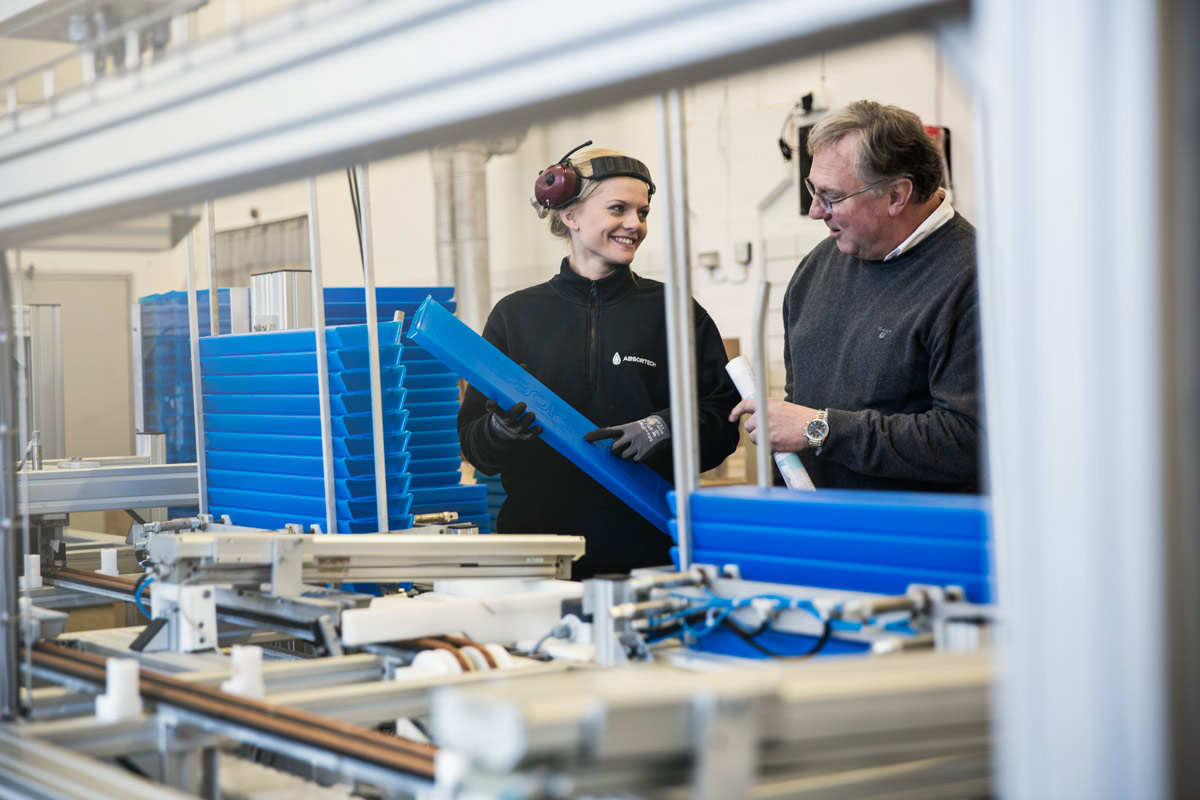
(Above, the Absorpole production line in 2017, when the collector was still blue. Today, it is made from 100% recycled plastic, giving it its characteristic grey colour.)
The purpose, however, remains constant: to help customers mitigate moisture impact and safeguard their cargo against moisture damage in transit. Absortech did not commence with a fully formed organisation or a flawless plan. It began with a genuine problem, with practical experimentation, and with the conviction that cargo could be protected more effectively.
Thirty years later, that remains the work.