
Key takeaways
- PPWR entered into force 11 Feb 2025 with most provisions applying from 12 Aug 2026
- The regulation is a framework — day-to-day compliance details depend on delegated acts still to come
- Key milestones expected through 2026-2028: labelling pictograms, substances of concern, reuse targets, design-for-recyclability
- Early preparation, rather than waiting for full clarity, is the more resilient path for packaging teams
The EU Packaging and Packaging Waste Regulation (PPWR) entered into force on 11 February 2025 (Regulation 2025/40 PPWR EUR), with most provisions applying from 12 August 2026. However, the regulation is best understood as a framework. Many technical details that will determine day-to-day compliance depend on delegated and implementing acts that the European Commission has yet to publish. F
or packaging compliance officers, sustainability managers, and regulatory affairs teams, the question is no longer whether PPWR will reshape packaging strategy, but how to stay informed as the rules take shape.
This article summarises which PPWR delegated acts are still expected, when they are due, and how packaging teams can prepare. Based on currently available information, the timeline below reflects the Commission’s stated intentions and may evolve as consultations progress.
Why the PPWR delegated acts matter
PPWR objectives vs. implementation details
PPWR sets binding objectives across recyclability, reuse, recycled content, empty space, labelling, and substances of concern. The headline targets are clear, but the methods, thresholds, and pictograms required to operationalise them are still being drafted. Until the delegated and implementing acts are finalised, certain compliance decisions cannot be made with full certainty.
Why this matters for moisture-sensitive packaging
This is particularly relevant for moisture-sensitive packaging, where design choices interact with recyclability criteria, weight optimisation, and material composition. The current interpretation among many industry observers is that early preparation, rather than waiting for full clarity, will be the more resilient path.
PPWR timeline 2026 2027 2028: what to expect
The following milestones reflect the Commission’s published expectations. Dates may shift, and packaging teams should monitor official channels for confirmation.
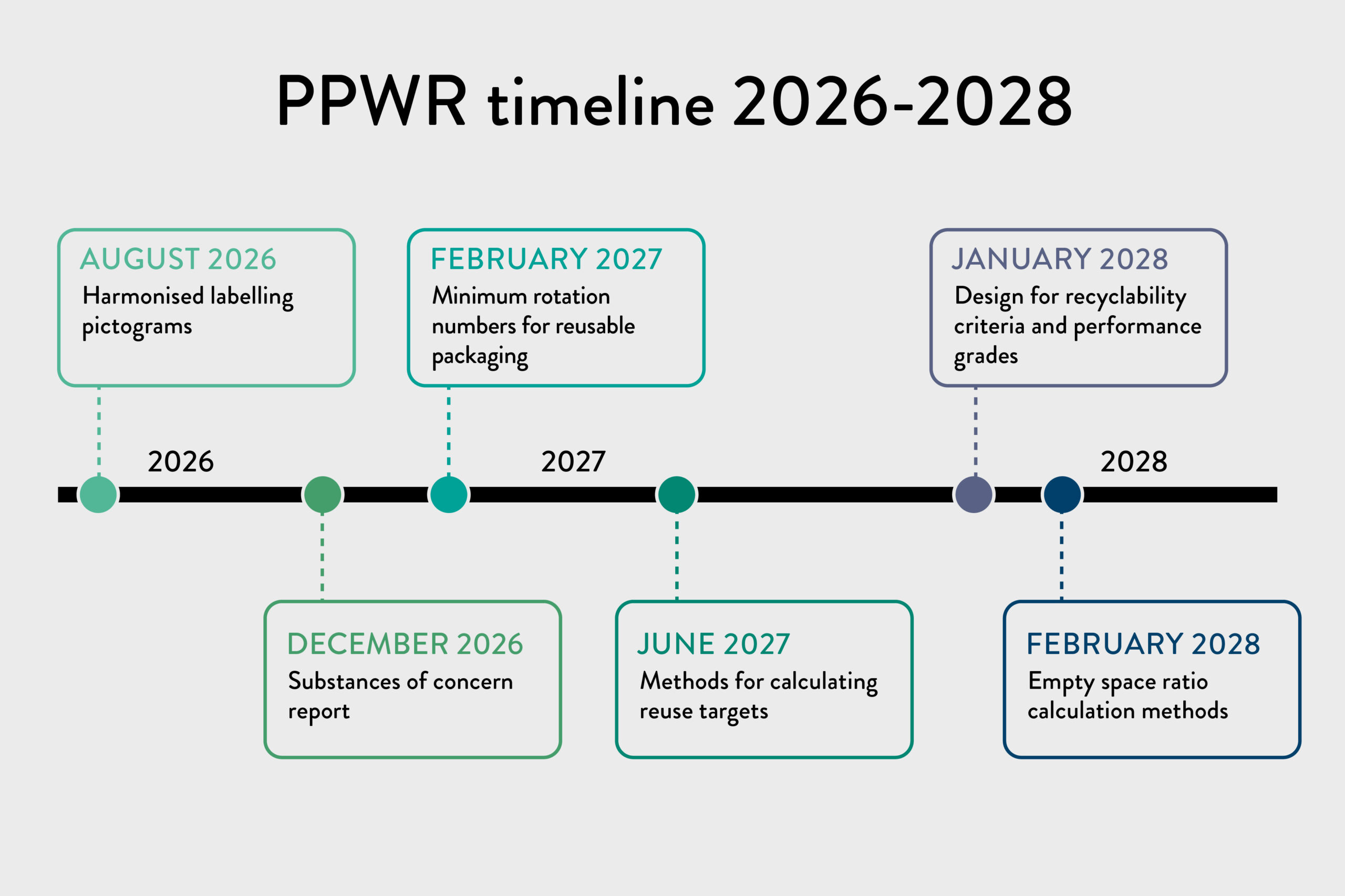
August 2026: harmonised labelling pictograms
An implementing act is expected to define harmonised pictograms for material composition and sorting instructions. These labels will apply to packaging placed on the EU market and will come into force two years after the delegated act is released, influencing artwork timelines for brand owners and converters.
December 2026: substances of concern report
The Commission, in cooperation with the European Chemicals Agency, is expected to publish a report on substances of concern in packaging, including how PFAS and similar substances affect reuse and recycling streams. The outcome may inform future restrictions and material substitution requirements.
February 2027: minimum rotation numbers for reusable packaging
Reusable packaging systems will be governed by minimum rotation requirements specifying how many cycles a unit must complete to qualify. The delegated act is expected to clarify these figures by category, with significant implications for transport and B2B packaging strategies.
June 2027: methods for calculating reuse targets
PPWR introduces reuse targets for several packaging formats. The calculation methodology, including which units count, how cycles are measured, and how exemptions apply, is expected by mid-2027.
January 2028: design for recyclability criteria and performance grades
One of the most consequential delegated acts will define Design for Recyclability (DfR) criteria and the associated recyclability performance grades (A, B, C). Packaging that fails to meet minimum grades will face market restrictions, and the criteria will determine which material combinations, barrier layers, and closures remain viable.
February 2028: empty space ratio calculation methods
PPWR Article 10 limits the empty space ratio in grouped, transport, and e-commerce packaging. The measurement methodology is expected in early 2028. For moisture-sensitive goods, weight and volume optimisation interact directly with desiccant selection: high-performing desiccants such as calcium chloride offer superior moisture absorption capacity per unit weight compared to low-performing desiccants like silica gel and clay, which is relevant for minimisation requirements.
Areas still open to interpretation
Beyond the scheduled delegated acts, several aspects of PPWR remain open. The classification of product categories that combine primary protection with transport functions may only be clarified as implementing guidance develops. Broad definitions in the regulation leave room for differing national interpretations, and early case practice will influence consensus.
Packaging that incorporates desiccants, oxygen scavengers, or other functional inserts may also see clarification on whether these components are treated as part of the packaging unit, as separate articles, or as product accessories. The current interpretation varies across member states.

Best practices: how to prepare while details are pending
While waiting for full regulatory clarity, packaging teams can take several proactive steps that align with a comprehensive prevention strategy.
1. Audit the packaging portfolio
A structured audit of current formats, materials, and suppliers establishes a baseline. Documenting weights, material composition, recyclability status, and use of substances of concern allows for faster response once delegated acts are published.
2. Document current compliance evidence
Maintain organised technical files for each packaging unit, including supplier declarations, recycled content certifications, and test reports. This documentation will be essential for conformity assessments under the future framework.
3. Begin material testing and qualification
Recyclability grades and empty space ratios will reward early innovation. Testing alternative materials, lighter formats, and precision-engineered desiccants now reduces the risk of last-minute reformulation. Tailored protection that mitigates moisture impact while supporting weight reduction is increasingly relevant.
4. Engage with the value chain
Suppliers, converters, distributors, and industry peers encounter the same interpretive questions. Continuous dialogue across the packaging value chain often surfaces emerging consensus faster than reading regulation alone.
Staying informed as PPWR develops
Several channels are worth monitoring as new delegated acts and EU packaging regulation updates are published.
- National authorities. Follow updates from competent authorities such as Naturvårdsverket in Sweden, Miljøstyrelsen in Denmark, and the Umweltbundesamt in Germany. National guidance often clarifies points the regulation leaves open.
- European Commission communications. The Commission’s environment portal publishes consultation drafts and adopted acts, offering earlier visibility than final publication.
- Specialised PPWR feeds. Generalist regulatory newsletters often miss the nuance relevant to moisture-sensitive packaging and functional inserts.
- Peer dialogue. Industry forums and working groups remain one of the fastest ways to compare interpretations and identify emerging best practice.
Conclusion and next steps
PPWR will continue to take shape through 2026, 2027, and 2028 as the Commission publishes its delegated and implementing acts. Based on currently available information, the most resilient approach is to treat the regulation as a moving target: audit now, document continuously, test materials early, and stay connected to authoritative sources.
Absortech is actively monitoring PPWR developments that may affect moisture protection in packaging and is committed to supporting customers as the regulatory landscape evolves. For expert guidance on aligning moisture protection strategies with PPWR requirements, contact the Absortech team or subscribe to receive future updates as new delegated acts are published.