Key takeaways
- AbsorDim delivers tailored protection during transit through precise, dimension-based moisture control.
- Correct dimensioning depends on cargo type, container volume, loading utilization, and voyage conditions.
- Precision-engineered desiccants reduce waste and support long-term reliability across diverse industries.
- Expert guidance from Absortech enables fast, customized implementation within days.
Moisture damage during container shipping and storage remains a persistent challenge for supply chain and quality teams. Humidity fluctuations create condensation that compromises goods, packaging, and reputation. AbsorDim, positioned within Absortech’s comprehensive prevention strategy, offers a structured, dimension-based approach to reliable moisture control. This article explains how AbsorDim works, who benefits, and how to implement it effectively.
Understanding moisture risk in containers
Sealed shipping units experience significant temperature cycling as they move through different climate zones. These fluctuations drive humidity changes that lead to condensation, corrosion, and product loss. Container rain and moisture released from cargo are among the most common causes of moisture-related cargo claims.
Importantly, the climate at the point of loading affects more than the air sealed inside the containment unit. It also influences the moisture content already present in goods and packaging materials that were stored in that climate before loading.
This matters because damage does not begin only at the moment condensation forms. Cardboard, pallets, and other packaging materials adsorb moisture from humid air well before the dew point is reached, gradually softening cartons and weakening load stability. Recognising this earlier onset of risk helps teams plan protection that covers the full journey rather than a single critical moment.
What causes container rain and condensation on cargo?
When warm, humid air inside a shipping container cools below its dew point, water vapour condenses on the ceiling and walls. This condensation, often called container rain, then drips onto cargo below. The same condensation can also form directly on cooler goods within the container.
Longer voyages compound this risk, since extended transit times typically pass through multiple climate zones with repeated temperature swings. A shipment loaded in a warm, humid port and delivered to a cooler destination will often experience several condensation cycles along the route.
Proactive risk management, rather than reactive claims handling, is the most dependable way to mitigate moisture impact. Teams that map their highest-risk routes, seasons, and cargo types can prioritise protection where it delivers the greatest value.
What is AbsorDim?
AbsorDim is a precision-engineered desiccant solution in which the correct type and quantity are calculated for each application, ensuring protection is matched to the actual moisture risk. Rather than adding desiccants by guesswork, AbsorDim is applied according to a calculated assessment of expected excess moisture, ensuring neither over-dimensioning nor under-dimensioning.

As detailed in the Step 2 DIMENSION brochure, AbsorDim represents the dimensioning phase of Absortech’s Peace of Moisture Mind process. This positioning ensures that product selection is grounded in data, not assumption.

How AbsorDim fits into a comprehensive prevention strategy
AbsorDim is one concept within a structured implementation process that spans assessment, dimensioning, application, and validation. The dimensioning step determines the type and quantity of desiccant required based on documented input data.
This structured approach ensures that moisture protection is tailored to each shipment rather than applied uniformly. A route through a single stable climate carries a different risk profile than a long voyage across several zones, and the dimensioning step accounts for that difference directly.
Teams seeking to understand the wider process can explore related guidance in the Moisture Magazine article on choosing the right container desiccant.
How AbsorDim mitigates moisture impact
AbsorDim operates through controlled moisture absorption, capturing excess humidity within the containment unit before it can condense. Calcium chloride based desiccants are classified as high-performing desiccants, offering superior absorption capacity compared with low-performing options such as silica gel and clay.
This distinction matters when planning protection. Absorption capacity refers to the total amount of moisture a desiccant can hold, which is the relevant measure for long-term reliability across an entire voyage.
Speed of uptake alone is not enough. A desiccant that absorbs quickly but saturates early leaves cargo exposed during the later stages of a long transit, which is precisely when repeated condensation cycles tend to occur.
Selecting the right quantity and placement
Correct dimensioning depends on several key variables, including cargo type, packaging moisture content, container volume, loading utilization (free air space), and transit duration through varying climate zones. It applies both to container desiccants and to inbound dry goods packaging, where excess moisture must be calculated for the specific goods and their packaging. The amount of unoccupied air space affects how the container or package breathes and how moisture behaves internally.
Placement also influences performance. Desiccants positioned to interact effectively with the internal air, rather than buried deep within tightly packed cargo, help maintain more even humidity control throughout the containment unit.
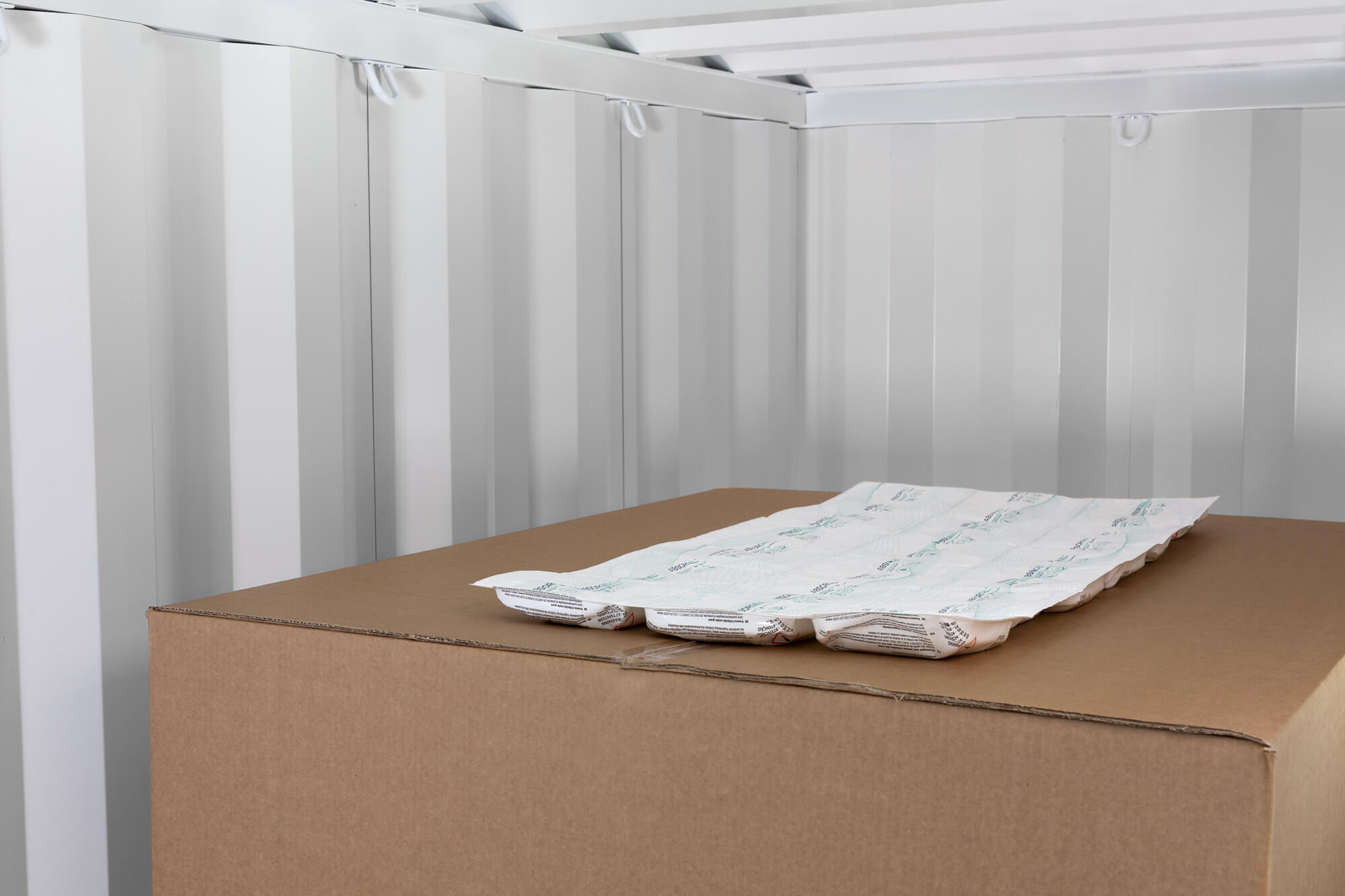
High-performing calcium chloride desiccants can specify absorption capacity of up to 300 percent of their own weight. For safe, real-world dimensioning, however, planning around 150 percent absorption capacity is recommended to ensure dependable conditions throughout transit.
Because these variables interact in complex ways, dimensioning is carried out by Absortech’s specialists rather than through a self-service calculator or published formula, ensuring that all relevant factors are accounted for. Request tailored moisture protection guidance to confirm the right configuration for a specific route.
Industries that benefit from AbsorDim
Moisture sensitivity spans a wide range of sectors, and AbsorDim is designed to serve diverse operational needs. Its structured application makes it suitable wherever goods travel through variable climates.
- Food and beverage: preventing mould on pallets and cartons, softening of packaging, rust on bottle caps, and peeling labels.
- Electronics: protecting sensitive components from corrosion and condensation.
- Pharmaceuticals: maintaining product integrity under strict quality requirements.
- Automotive, textiles, and industrial goods: guarding against staining, mould, mildew, and corrosion.
Across these industries, the priority is often mould on pallets and cartons, followed by soft or collapsed cartons and damage to outer packaging. Addressing these vulnerabilities early is central to enhancing product quality and reducing costly claims.
The financial consequences extend beyond the value of the goods themselves. Rejected shipments trigger repackaging, re-inspection, delayed deliveries, and strained customer relationships, all of which reinforce the case for proactive moisture protection.
Sustainability and value considerations
Reducing moisture damage directly reduces waste, since fewer goods are rejected, repackaged, or discarded on arrival. This supports both sustainable solutions and stronger commercial outcomes for supply chain teams.
Weight efficiency is also an increasing priority. As packaging minimization regulations such as the EU Packaging and Packaging Waste Regulation (PPWR) take effect, high-performing calcium chloride desiccants offer an advantage due to their superior weight-to-absorption capacity ratio compared with silica gel and clay. Notably, PPWR requirements under delegated acts typically come into force two years after the delegated act is released, which affects compliance planning for packaging teams.
PPWR is also expected to reduce the amount of packaging material used, which can increase the risk of soft cartons as protective layers are minimised. In this context, dependable moisture control becomes an important safeguard for maintaining load integrity, and design choices that support recyclability and reuse strengthen the sustainability case further.
Implementing AbsorDim in the supply chain
Implementing AbsorDim follows a structured implementation process rather than a single purchase decision. The dimensioning phase draws on documented inputs, including type of goods, transport duration, mode of container loading, and any current solution already in use.
From these inputs, Absortech calculates the expected excess moisture, references historically validated field test data, and proposes a suitable type and quantity of desiccant. When desiccants are installed, sealing container vents is recommended to maintain controlled internal conditions during dry cargo shipments.
Validation closes the loop. Reviewing results after early shipments confirms whether the applied configuration performs as expected, allowing refinements before the approach is scaled across additional routes or higher volumes.
Working with expert guidance for tailored protection
Rather than navigating a lengthy self-guided process, supply chain teams can rely on Absortech’s experience with customers across humidity-affected sectors. This trust-based route provides tailored recommendations and fast implementation, often within days.
Assessment leads directly to a customized prevention plan, complete with cost and CO2 savings calculations where sufficient data is shared. This ensures that protection is neither over-dimensioned nor under-dimensioned, optimizing safety and value simultaneously.
Teams evaluating their options can begin with a short conversation to define scope and priorities. Sharing basic details such as route, cargo type, and historical damage patterns is often enough to shape a practical first recommendation.
Conclusion
AbsorDim represents a reliable, precision-engineered choice for container moisture protection. By grounding desiccant selection in structured dimensioning, it delivers tailored protection that mitigates moisture impact throughout transit and storage.
For organizations facing recurring moisture damage, the overlooked step is often correct re-dimensioning rather than simply adding more desiccants. Embedding AbsorDim within a comprehensive prevention strategy supports long-term reliability, reduces waste, and protects product quality across diverse industries.
To explore how AbsorDim fits a specific supply chain, explore AbsorDim for reliable protection. Teams preferring ongoing insights can also subscribe to the Absortech Moisture Magazine newsletter for regular expert guidance.