Among the many obligations introduced by the EU Packaging and Packaging Waste Regulation (PPWR), one stands out for its immediate enforcement: the restriction on per- and polyfluoroalkyl substances (PFAS) in food-contact packaging. While most PPWR requirements phase in gradually, the PFAS limit applies from day one when the regulation enters into application on 12 August 2026.
For food and pharmaceutical companies shipping goods, this is a hard deadline with direct consequences for how paper-based packaging performs against grease, oil, and water.
Key takeaways
- PPWR Article 5 restricts substances of concern in packaging, including a strict PFAS limit for food-contact materials and long-standing concentration limits on heavy metals (lead, cadmium, mercury, and hexavalent chromium).
- The PFAS restriction applies immediately from 12 August 2026, not through a phased timeline, as food safety analysis of the August 2026 deadline confirms.
- PFAS has long provided grease, oil, and water resistance in paper-based food packaging.
- Removing PFAS changes the moisture performance of food-contact paper, requiring alternative barriers and validation.
- Companies placing packaging on the EU market must demonstrate compliance through supplier declarations and test documentation.
Understanding PPWR Article 5 and substances of concern
Article 5 of the PPWR, as set out by the European Commission’s packaging waste framework, establishes a basis for restricting substances of concern in packaging and packaging components.
The intent is to ensure that packaging placed on the EU market does not compromise human health, the environment, or the recyclability and reuse of materials. The provision covers substances that may leach into the environment during recycling or that hinder the circular use of packaging materials.
Alongside PFAS, Article 5 carries forward long-standing restrictions on heavy metals (lead, cadmium, mercury, and hexavalent chromium) in packaging, capping the sum of their concentration levels. The most immediate new obligation under this framework, however, concerns PFAS in food-contact packaging.
According to the European Commission, packaging in contact with food may not be placed on the market if PFAS are present above defined thresholds.
This should be read as a current interpretation of the Article 5 requirement, as specific scope details and test methodologies may be clarified by further guidance.
Why the PFAS limit is a day one obligation
Unlike Article 10 minimisation rules or recycled-content targets that follow staggered timelines, the PFAS restriction takes effect the moment the regulation applies. There is no transition window.
Packaging buyers who assume they have years to adapt risk placing non-compliant products on the market from the first day of enforcement. For teams specifying food-contact paper, pouches, and moulded-pulp formats, the practical planning horizon is already short.
A reformulation cycle for a fibre-based pack, from barrier selection through supplier qualification and shelf-life validation, can easily take longer than the window that remains, which is why the date should be read as an immediate procurement trigger rather than a distant milestone.
What PFAS has done in packaging
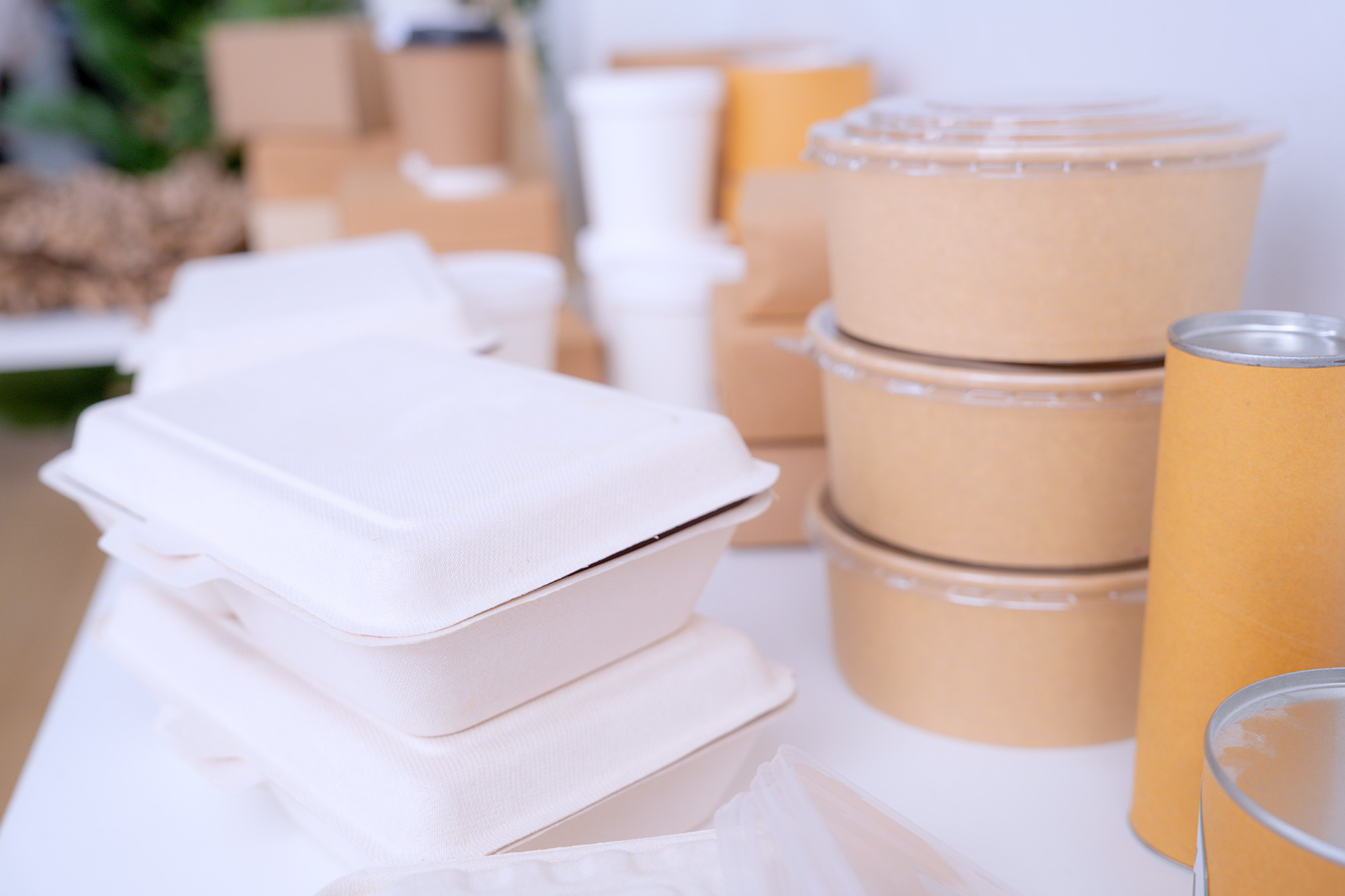
PFAS have historically been valued precisely for the properties that make them problematic in the environment. Their resistance to water, oil, and grease made them a reliable coating for paper-based food packaging where grease and liquids would otherwise soak through fibre materials. Common applications include:
- Burger and sandwich wrappers
- Bakery liners and pastry bags
- Moulded-pulp bowls and trays
- Popcorn bags and microwave popcorn liners
In each case, PFAS delivered a thin, effective barrier that allowed lightweight fibre packaging to hold oily or moist foods without degrading. Research published in ScienceDirect notes that the fibre-based sector has depended heavily on such fluorinated treatments to achieve grease and moisture resistance, which is why the transition away from them presents a genuine technical challenge.
The same properties that made PFAS attractive for a hot, greasy meal wrapper also make them persistent in recycling streams and the wider environment, and it is this durability that Article 5 targets.
What happens when PFAS is removed
Removing PFAS does not simply change a chemical on a specification sheet. It removes a functional barrier. Without it, food-contact paper loses much of its resistance to grease and moisture, and the packaging becomes more vulnerable to softening, staining, and structural weakening.
This matters well before any visible failure occurs, because fibre-based materials begin absorbing moisture from the surrounding air long before condensation or dew point is reached.
Alternative barriers and their trade-offs
Several PFAS-free barriers are already in use, each with a different moisture performance and recyclability profile. According to Packaging Dive, adoption of these alternatives is accelerating as regulatory pressure grows. The main options include:
| Barrier type | Moisture performance | Recyclability and reuse |
|---|---|---|
| Wax coatings | Moderate moisture resistance | Can complicate fibre recycling |
| Silicone treatments | Good grease resistance, variable moisture control | Generally compatible with recycling streams |
| Bio-based coatings | Variable, formulation dependent | Often designed for recyclability |
| Aluminium laminate | High moisture and grease barrier | Reduces fibre recyclability |
No single alternative matches PFAS across all criteria. A barrier that restores moisture resistance may reduce recyclability, while a highly recyclable coating may offer weaker protection. This is why substituting one barrier for another cannot be a paper exercise.
The moisture behaviour of each option needs to be understood in the context of the specific product and its supply chain. A bio-based coating that performs well under mild conditions may struggle when exposed to prolonged humidity or temperature variation, so the evaluation criteria should include the toughest conditions the packaging will realistically face, not just the average case.
The wider substances of concern picture
PFAS is not the only substance of concern addressed by the PPWR. Article 5 also maintains the established restrictions on heavy metals, capping the combined concentration of lead, cadmium, mercury, and hexavalent chromium in packaging and its components.
Together with the PFAS limit, these form the current core of the substances of concern framework, but they are the first, not the last, chapter in the PPWR story.
The Commission and the European Chemicals Agency are required to produce a report by December 2026 examining substances of concern in packaging, as noted in a Eurofins chemicals bulletin, including how PFAS and other chemicals affect reuse and recycling. Further restrictions may follow once that assessment is complete, and any such requirements introduced via delegated acts would typically come into force around two years after the delegated act is released.
For packaging teams, this means the PFAS limit should be treated as the leading edge of a broader regulatory direction rather than an isolated requirement. Decisions made now about alternative materials should anticipate that additional substances may come under scrutiny, and that recyclability and reuse will remain central evaluation criteria.
Choosing a replacement barrier purely to solve today’s PFAS obligation, without considering how it fits future circularity expectations, risks a second costly reformulation within a few years.
Packaging ownership and technical documentation
Under the PPWR, the economic operator placing packaging on the EU market carries responsibility for demonstrating compliance with substance restrictions, as clarified in the European Commission’s packaging waste guidance. In practice, this obligation increasingly translates into concrete procurement requirements. Buyers should expect the following to become standard asks:
- Supplier declarations confirming PFAS-free status
- Material test reports validating substance thresholds
- Conformity assessments supporting the technical documentation
These documents are not optional formalities. In the event of market surveillance, the economic operator must be able to show that its packaging meets Article 5 requirements.
Building a documentation trail through the supply chain now avoids scrambling for evidence after enforcement begins. It is also worth mapping which internal function owns this evidence, as responsibility often sits between procurement, quality, and regulatory teams, and gaps tend to appear where ownership is unclear.
Best practices: what companies should do now
The clarity of this obligation allows for a definitive action plan. The following steps address the most pressing priorities for food and pharmaceutical packaging teams.
1. Audit food-contact packaging for PFAS
Begin by identifying every food-contact packaging format in the portfolio that may contain PFAS. Fibre-based items with grease or moisture resistance are the natural starting point. This audit establishes the scope of the compliance task and highlights which formats require reformulation before the deadline. Prioritising by volume and by how central each format is to the product line helps focus effort where non-compliance would be most disruptive.
2. Request supplier declarations early
Contact suppliers to obtain declarations and supporting test data. Because the economic operator bears the compliance burden, waiting for suppliers to volunteer this information is not advisable. Early requests also reveal which suppliers are prepared for the restriction and which may need support to meet it, giving buyers time to qualify alternative sources before the deadline forces a rushed decision.
3. Test the moisture performance of alternatives before scaling
Perhaps the most important step is validating that a PFAS-free alternative actually protects the product. Switching at scale without testing risks trading a compliance problem for a quality problem. The moisture performance of a new barrier should be assessed under realistic storage and transport conditions, including humidity and temperature variation across climate zones during longer voyages.
This is where moisture expertise becomes valuable. Absortech supports food and pharmaceutical companies in evaluating how PFAS-free packaging behaves against moisture, helping teams mitigate moisture impact and maintain product quality through the transition.
Where a reformulated fibre pack shows reduced barrier performance, a comprehensive prevention strategy that combines packaging choices with precision-engineered desiccants can restore reliable, long-term protection without reintroducing restricted substances.
Conclusion and next steps
The PPWR PFAS restriction is one of the clearest and earliest-enforced obligations in the entire regulation.
From 12 August 2026, food-contact packaging containing PFAS above defined limits may not be placed on the EU market, and the responsibility for demonstrating compliance rests with the economic operator. Removing PFAS restores environmental integrity, but it also removes a proven moisture and grease barrier, making validation of alternatives essential rather than optional.
Companies that audit their packaging, secure supplier declarations, and test PFAS-free alternatives now will enter enforcement prepared rather than exposed. For teams weighing the moisture implications of these changes, Absortech offers expert guidance and tailored protection grounded in decades of experience with moisture-sensitive supply chains.
To discuss how PFAS-free packaging can be validated for moisture performance, contact the Absortech team, or subscribe to the Moisture Magazine newsletter to follow the evolving PPWR requirements as further guidance is published.