
The real cost of reactive moisture management
Moisture damage represents one of the most persistent and financially significant risks in global supply chains. According to Absortech’s analysis of moisture damage costs, the financial impact extends far beyond the immediate loss of goods, encompassing insurance claims, customer disputes, brand erosion, and the operational disruption of managing returns and replacements. Many of these consequences remain invisible until they compound into significant liability. many of these consequences remain invisible until they compound into significant liability.
The fundamental challenge is not that moisture damage is unavoidable. It is that most organisations respond to it after it occurs. Claims are filed, product is written off, and adjustments are made on an ad hoc basis. This reactive posture is both costly and unsustainable. What supply chain professionals require is not simply a desiccant product, but a comprehensive prevention strategy grounded in data, diagnostics, and structured implementation.
Absortech’s response to this challenge is a methodology, not merely a product. Through the AbsorTest™ diagnostic process and the overarching Peace of Moisture Mind® (POMM) framework, Absortech delivers a proactive, science-backed approach to moisture risk that transforms how businesses protect their goods from origin to destination.
Understanding moisture risk: why generic solutions fall short
To appreciate why a structured, diagnostics-led methodology is necessary, it is important to first understand the complexity of moisture risk in transit environments. Moisture does not behave predictably. It responds to a wide range of interacting variables, each of which can amplify or diminish the risk of damage at any given point in a shipment’s journey.
The variables that determine moisture risk are numerous and interactive:
- Ambient humidity at the origin and destination ports, and throughout the transit route
- Transit duration, including layovers, port congestion, and multi-modal handoffs
- Packaging material moisture content, which varies by season, supplier, and storage conditions
- Product sensitivity, which differs significantly between electronics, pharmaceuticals, food commodities, textiles, and industrial components
- Container microclimate, which is influenced by cargo type, loading density, and vessel positioning
Generic desiccant solutions, selected by weight category or rule of thumb, frequently fail because they cannot account for this multitude of variables. Improper sizing, placement, and desiccant type selection are among the most common causes of protection failure. For example, calcium chloride (CaCl₂) desiccants are most suitable for container shipping environments, while clay or silica gel may be inadequate for these conditions. These factors can result in either under-protection that leads to damage claims, or over-protection that generates unnecessary cost and waste. This is precisely the gap that AbsorTest and the POMM methodology are designed to close.

What is AbsorTest? Understanding the diagnostic foundation
Before any protection strategy can be designed, the specific moisture risk profile of a shipment must be accurately understood. This is the purpose of AbsorTest, Absortech’s proprietary diagnostic evaluation process that establishes the data-informed foundation for every tailored protection recommendation.
AbsorTest removes the guesswork that characterises generic desiccant procurement. Rather than applying a one-size-fits-all solution, Absortech’s specialists conduct a structured assessment that examines the following critical variables:
- Climate and route exposure: The humidity levels, temperature fluctuations, and weather patterns encountered along a specific shipping lane or storage environment.
- Cargo profiling: The moisture sensitivity, hygroscopic properties, and packaging configuration of the goods being protected.
- Packaging evaluation: The moisture content of packaging materials themselves, including pallets, cartons, and lining, which can contribute significantly to internal humidity levels.
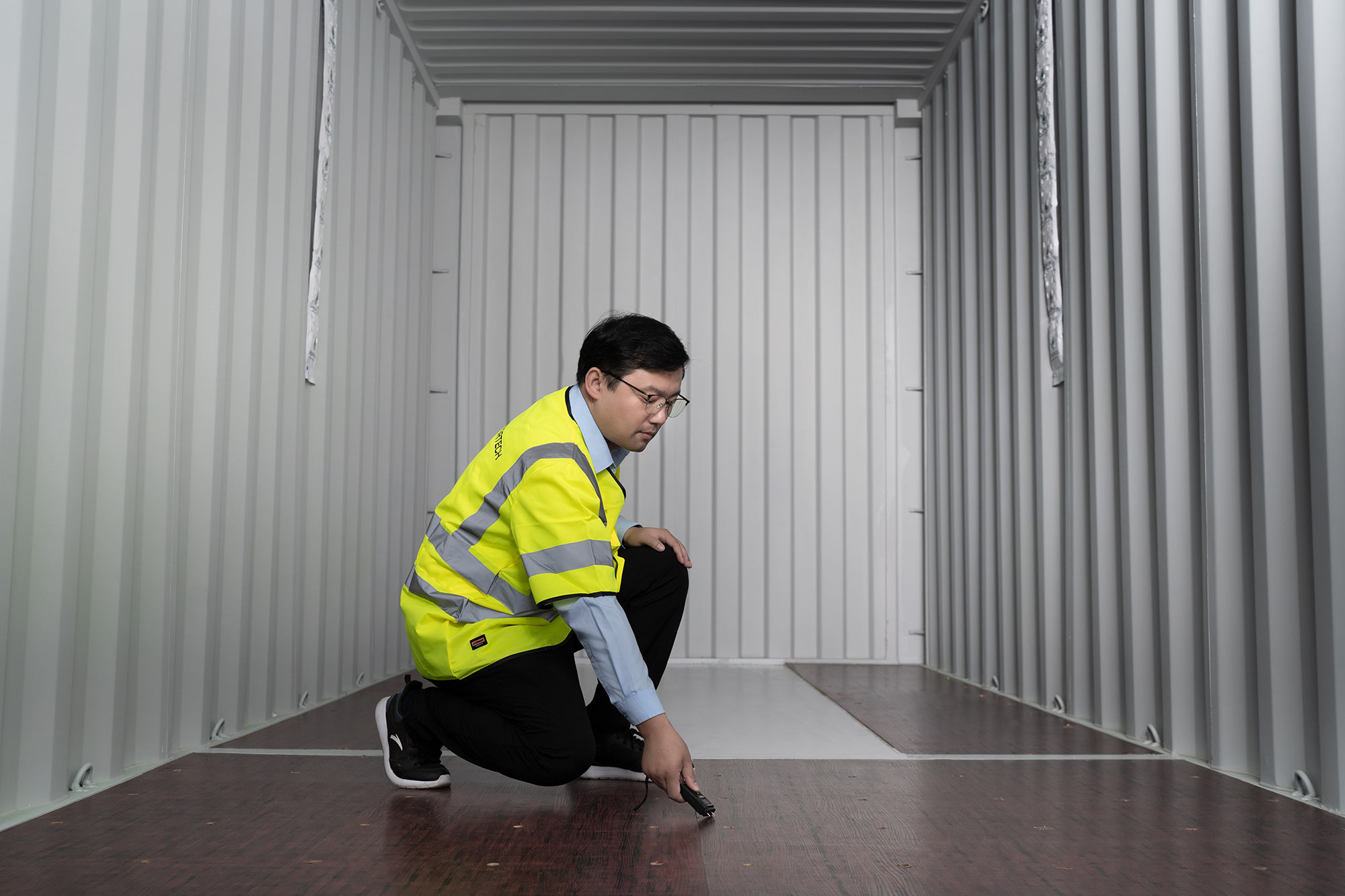
- Container condition assessment: The integrity of the shipping container, including floor condition, seal quality, and placement on the vessel, whether above or below deck, and within or at the edge of a stack.
- Transit duration analysis: The total time from container loading to container opening, inclusive of port dwell times and inland transport legs.
The output of AbsorTest is a data-driven insights profile specific to the client’s operational context. This diagnostic foundation ensures that subsequent recommendations are not theoretical assumptions but validated conclusions drawn from measurable evidence. Industry guidance on desiccant use in logistics consistently demonstrates that the effectiveness of any moisture protection solution is directly proportional to the accuracy of the risk assessment that precedes it.

Introducing POMM: the Peace of Moisture Mind® methodology
Peace of Moisture Mind® (POMM) is Absortech’s structured, end-to-end framework for moisture damage prevention. Developed over decades of operational experience across diverse industries and shipping environments, POMM is what elevates Absortech from a product supplier to a strategic partner in supply chain integrity.
POMM is built on four sequential, interdependent steps. Each stage generates outputs that feed directly into the next, creating a complete moisture protection lifecycle. Understanding each step in detail is essential to appreciating how the methodology delivers consistent, verifiable results.
Step 1: Audit
The process begins with a thorough audit of the client’s packaging and loading environment. An Absortech specialist, either on-site or via a structured digital assessment, evaluates approximately 60 parameters across 13 operational areas. The objective is to identify sources of excess moisture introduced during the packaging process itself, and to assess whether current protection measures are appropriately dimensioned.
The AbsorAudit can be conducted in two ways:
- Complete (on-site): An Absortech specialist accompanies a client representative through the packaging process at the client’s facility, documenting findings with photographs and a structured questionnaire.
- Lite (web-based): The client provides input data guided by a digital questionnaire, complemented by web meetings with an Absortech expert.
Regardless of format, findings are presented in a formal report with corrective action proposals. This report directly informs the dimensioning step that follows.
Step 2: Dimension
Using data gathered during the audit, Absortech’s experts calculate the precise quantity and type of precision-engineered desiccants required to mitigate the identified moisture risk. This dimensioning process combines theoretical modelling with historically validated field data from comparable shipments.
Absortech’s dimensioning approach draws on three sources of evidence:
- Theoretical calculation: An estimate of the expected volume of excess moisture that will likely need to be absorbed, based on route, cargo, and environmental data.
- Historical field data: A validated dataset from prior shipments across a range of goods and routing configurations.
- Existing solution benchmarking: Where a client already uses a desiccant solution, this is evaluated as a practical reference point.
The output includes a tailored desiccant specification, a cost quotation, and, where applicable, projected cost and CO2 savings compared to the client’s existing solution.
Step 3: Validate
Validation is the scientific confirmation that the dimensioned solution performs as intended under real-world conditions. This stage leverages the diagnostic insights gathered during the initial AbsorTest evaluation to design targeted field tests. Field tests are conducted using live shipments, with desiccants installed in actual containers aboard actual vessels. Test configurations are carefully controlled, using the same goods, the same loading arrangement, and the same vessel placement, to generate reliable, comparable data.
This step is critical because laboratory modelling, however rigorous, cannot fully replicate the dynamic conditions of an active shipping environment. The validation process builds directly on the AbsorTest foundation, ensuring that the recommended solution delivers verified protection before full-scale implementation, providing clients with documented evidence of performance.
Step 4: Implement
The final stage encompasses the structured rollout of the validated moisture protection solution across the client’s supply chain. This includes ensuring that the correct desiccants are available at the point of need, that loading and packaging personnel are appropriately trained, and that the entire process is systematised for consistent execution.
Implementation is not a one-time event. POMM’s final phase transforms a validated recommendation into an operational standard, embedded within the client’s existing logistics processes and subject to ongoing review as supply chain conditions evolve.
Together, these four steps constitute a structured implementation process that leaves no variable unaddressed.
POMM is not a checklist. It is a living framework that adapts to the complexity of each client’s supply chain.
Why a process-driven approach matters
POMM accounts for all relevant moisture risk variables systematically. By moving through audit, dimensioning, validation, and implementation in sequence, the methodology ensures that no critical factor is overlooked and that the resulting protection strategy is both proportionate and verifiable. This is the essence of proactive risk management, addressing moisture exposure before it manifests as damage, rather than managing its consequences after the fact.
The distinction matters commercially. Case study evidence from global food export operations demonstrates that a structured, diagnostics-led approach to moisture protection consistently outperforms reactive or generic alternatives, delivering measurable reductions in product loss and claims frequency. For organisations operating at scale, the cumulative financial benefit of a validated prevention strategy significantly outweighs the cost of implementation.
Real-world benefits of the POMM methodology
Organisations that implement POMM as their comprehensive prevention strategy consistently report outcomes across five key dimensions:
- Reduced product claims and returns: Validated protection strategies significantly lower the incidence of moisture-related damage, reducing the frequency and value of insurance claims, customer complaints, and product write-offs.
- Optimised desiccant usage: Precision dimensioning eliminates both over- and under-protection, ensuring that desiccant quantities are calibrated to actual need, generating measurable cost efficiencies without compromising protection standards.
- Verified, data-backed confidence: Field validation provides documented evidence that the recommended solution performs under real shipping conditions, supporting compliance requirements and internal quality assurance processes.
- Sustainable solutions at scale: By reducing excess desiccant usage and minimising product waste attributable to moisture damage, POMM contributes directly to an organisation’s environmental performance objectives, aligning long-term reliability with responsible resource management.
- Supply chain-wide consistency: Systematised implementation ensures that moisture protection standards are applied uniformly across facilities, logistics partners, and shipping routes, eliminating the variability that undermines reactive approaches.
These outcomes are not incidental. They are the direct result of a methodology designed from the outset to deliver measurable, repeatable, and auditable results, the hallmarks of expert guidance applied at an institutional level.
How to get started with AbsorTest
Initiating an AbsorTest evaluation is the first and most consequential step toward establishing a validated moisture protection strategy for your supply chain. The process is structured to be accessible and minimally disruptive. Absortech’s specialists work with your existing operational data and, where required, conduct on-site or digital assessments to build an accurate risk profile.
Whether your organisation manages high-volume container shipping, temperature-sensitive pharmaceutical logistics, or complex multi-modal distribution networks, AbsorTest provides the diagnostic clarity required to make informed, data-driven protection decisions. To learn more about the AbsorTest process, visit Absortech’s AbsorTest page, or explore the full Peace of Moisture Mind® methodology.
Organisations that engage with the POMM process do not simply acquire a desiccant solution. They establish a structured, evidence-based approach to moisture risk that evolves with their supply chain. To begin that process, contact Absortech’s specialists directly and initiate your AbsorTest evaluation.
Conclusion: a partnership built on methodology, not just product
Absortech’s value proposition is fundamentally distinct from that of a conventional desiccant supplier. Through AbsorTest and the POMM framework, Absortech delivers a comprehensive prevention strategy that is scientifically grounded, operationally validated, and tailored to the precise conditions of each client’s supply chain.
For organisations committed to enhancing product quality and achieving long-term reliability in moisture-sensitive logistics, partnering with Absortech represents a structural improvement, not merely a procurement decision.